This is something of a departure from my usual subject matter. However; when I came across this gentleman’s life story as part of a planning session at school, I felt I had to look a little more deeply and share it with people. I had never heard of him before but it turns out that he was an inspiration for Sir Arthur Conan Doyle when he came up with the character of Professor Challenger in his story, The Lost World. He’s also touted as being one of the inspirations behind Indiana Jones. Colonel Percy Fawcett is held up by some as a fearless adventurer who set out in search of cities of gold and never returned. Here I’m going to tell you what I’ve found out about the man, the myth and the reality.

Percy Fawcett was born on August 18th, 1867, in Torquay. His father, Edward, was born in India and was a long-time member of the Royal Geographical Society (RGS), which may account for his son’s interest in such matters. Percy also had an older brother, Edward, who was a renowned mountaineer and author of adventure novels.
Percy was enrolled in the military academy in Woolwich before receiving his commission as a lieutenant in the Royal Artillery in 1886. He attained the rank of Captain, serving in various places including India. It was there that he met his wife, Nina.
He had a keen interest in mapmaking and surveying and so in 1901 he became a member of the RGS, following his father’s footsteps. As a surveyor, he was called upon to work for the British Secret Service in North Africa. He also struck up friendships with authors H Rider Haggard and Arthur Conan Doyle.
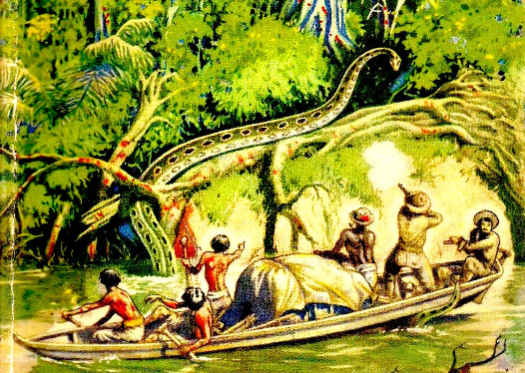
His interest in South America began in 1906 with a commission from the RGS to go and survey the jungle area between Brazil and Bolivia as part of a boundary dispute resolution. During his time there, he made some outlandish claims which did nothing for his reputation in the scientific community. Among these were his reports of a 62ft anaconda and dogs with two noses, the latter of which may actually have had some basis in fact. This initial foray into the Amazon was transformative, though. Encounters with the dense jungles, amazing wildlife, and indigenous tribes sparked an obsession with the region.
At the outbreak of the Great War in 1914, Fawcett returned to Britain to join the efforts. He commanded an artillery brigade even though he was aged 50.
By this time, Percy Fawcett had developed a compelling theory about a “lost city” he called “Z,” believed to be hidden deep in the Mato Grosso region of Brazil. Based on extensive documentary research, Fawcett speculated that the area was once home to a sophisticated civilization, remnants of which might still be found among the region’s ruins.
Another inspiration for his exploration was ‘Manuscript 512’, a document housed in the National Library of Rio de Janeiro. Authored in the 18th century, likely by Portuguese explorer João da Silva Guimarães, the manuscript details the discovery of a ruined city in the sertão of Bahia. The description included grand arches, statues, and a temple adorned with hieroglyphics. However, no precise location was provided. While Fawcett’s primary focus remained the search for Z, this mysterious city became a secondary goal.

During his time in Brazil, Fawcett carried a curious jade (or possibly basalt) statuette that he claimed possessed supernatural powers. It was given to him by his friend, H Rider Haggard. Wondering about its origins, Fawcett apparently had it examined by a medium who claimed it came from a land between Africa and North America. This would have been welcome news to the man who already was convinced of the existence of Atlantis. Inscribed with markings on its chest and feet, he reportedly used the idol to command respect and influence among indigenous tribes. He once confided to Brazilian General Ramiro Noronha that merely showing the artifact allowed him to exercise “irresistible power over the natives.” Whether this claim was true or a strategic ploy remains unclear, but it adds another layer of intrigue to the explorer’s enigmatic life and methods. Experts are convinced that this carved idol was nothing more than a fake that was passed off on Haggard who in turn gave it to his explorer friend.
Fawcett’s belief in the existence of was influenced by legends, historical accounts, and the discovery of mysterious artifacts, including pottery shards and carved stones, in the region. In 1920, Fawcett wrote about his theories in a letter to the RGS, describing Z as a place of monumental ruins, built by a highly developed people. While his claims were met with a brick wall of scepticism by the academic community, they captured the imagination of the public. The idea of an Atlantis-like civilization hidden in the jungle resonated with a world enthralled by the spirit of adventure.
Fawcett’s expeditions into the Amazon were fraught with challenges. He faced treacherous rivers, deadly wildlife, and the constant threat of disease. His 1913 expedition to the Heath River in Bolivia, for instance, was marked by violent encounters with hostile tribes, who shot arrows at his party. Yet, Fawcett’s ability to remain calm and his knack for diplomacy often allowed him to navigate such dangers unscathed.
Another constant challenge was the jungle itself—a labyrinth of dense foliage, swamps, and towering trees that could easily disorient even the most experienced explorer. Fawcett’s determination and resourcefulness, however, earned him a reputation as a true jungle survivor.
In April 1925, Fawcett embarked on what would be his final expedition. Accompanied by his eldest son, Jack, and Jack’s friend, Raleigh Rimell, Fawcett set out to locate Z. The trio was well-prepared and had the backing of various sponsors, including newspapers eager for stories of adventure.

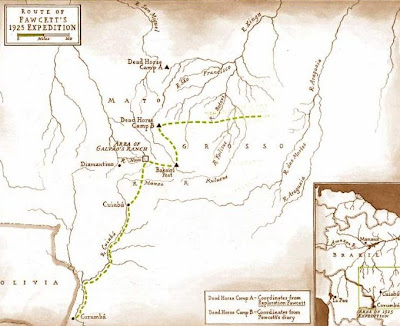
The group’s progress, along with Brazilian guides, was initially tracked through letters sent back to civilization. They faced severe challenge, mainly from the swarming insects that filled the air. Gnats and mosquitoes accounted for miserable travelling conditions and extreme sleep deprivation. Then, after reaching a location near the Xingu River known as Dead Horse Camp, he dismissed his native guides and all communication ceased.

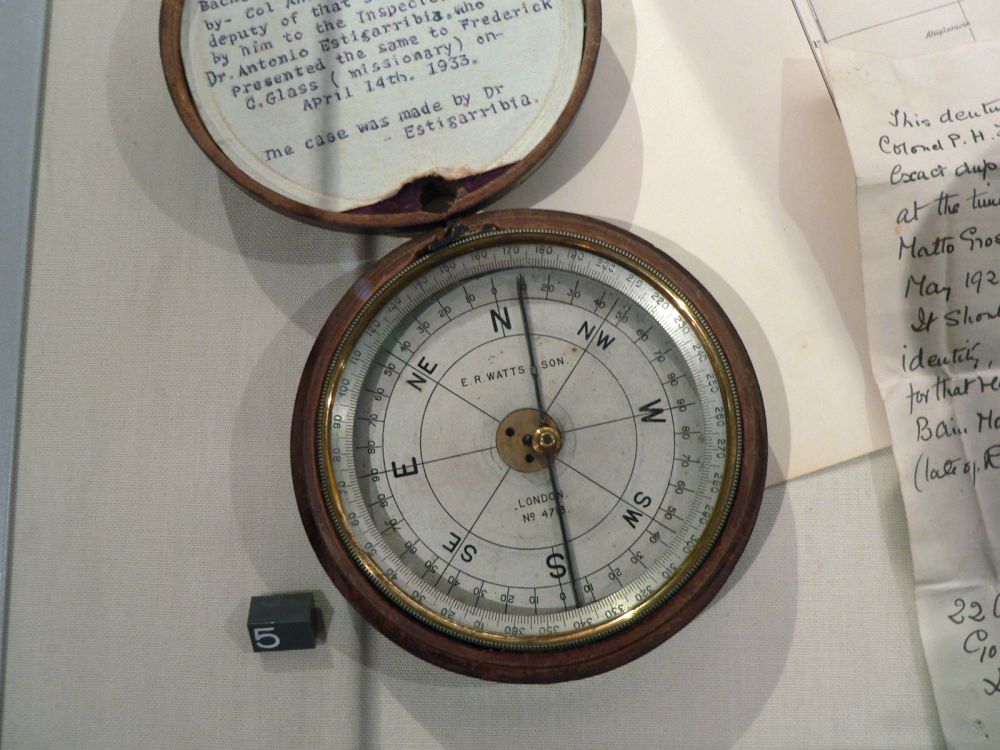
The only definite trace of him was his compass, which was posted back to Nina after being discovered in 1933 after being lost in a previous expedition. It now resides in the Torquay museum.
When no word came from Fawcett, speculation about his fate ran wild. Some believed he had been killed by hostile tribes, while others suggested he had succumbed to disease or starvation. A few even entertained the idea that he had discovered Z and chosen to remain there. His disappearance sparked numerous rescue attempts, with adventurers and fortune seekers venturing into the Amazon to uncover his fate. None succeeded, and many met tragic ends themselves.
Over time, theories about what happened to Fawcett have proliferated. Some suggest he was killed by the Kalapálo tribe, though other accounts from their descendants indicate they treated him with respect. John Hemming (1 April 2017), writing for The Spectator, says that “Chief Comatsi of the Kalapalo tribe gave a very detailed account of Fawcett’s visit, reminding his assembled people of exactly how they had killed the unwelcome strangers. But the German anthropologist Max Schmidt, who was there in 1926, thought that they had plunged into the forests, got lost, and starved to death; this was also the view of a missionary couple called Young who were on another Xingu headwater. The Brazilian Indian Service regretted that Fawcett, who was obsessively secretive, had not asked for their help in dealing with the Indians. They felt he was killed because of the harshness and lack of tact that all recognised in him.
” Brazilian explorer Orlando Villas Boas investigated the location where they were reportedly murdered and found human remains and personal possessions including a knife and some buttons. This is strange. Some sources say that he was very good and respectful with indigenous people; others paint him as rude and harsh.

As stated above, others say that he may have been a victim of jungle fever or starvation. Countless theories, ranging from plausible to outright fantastical have been put forward. The most outlandish ideas veer into the supernatural.
Some believe that Fawcett stumbled upon an ancient portal or gateway to another dimension, perhaps even being transported to a mythical land. Fawcett himself was reportedly interested in mysticism and the occult, which has fuelled these claims. His membership in the Theosophical Society and his association with ideas of spiritual ascension have been cited as influences.
Others suggest extra-terrestrial involvement, arguing that Z was not a city at all but an alien outpost. The theory that the “Lost City of Z” was an extra-terrestrial outpost has been explored in UFO and alien-focussed literature. Erich von Däniken’s Chariots of the Gods? (1968) doesn’t directly mention Fawcett but popularized the notion of ancient civilizations being influenced by extra-terrestrials. This has since been tied to Fawcett by modern UFO theorists.
Finally, a few propose that Fawcett intentionally faked his disappearance, either to escape financial troubles or to live undisturbed in the jungle. This seems unlikely, however.
Despite numerous searches, no definitive evidence of Fawcett’s fate (apart from the bones which have never been tested) has ever been found. His disappearance remains one of the greatest unsolved mysteries of exploration.
Beyond the riddle of his disappearance along with his whole party, Fawcett’s legacy lies in his contributions to cartography and his enduring spirit of curiosity. His life and adventures have inspired countless works of fiction and nonfiction, including the 2016 film The Lost City of Z, based on David Grann’s best-selling book.
Modern archaeological discoveries have lent some credibility to Fawcett’s theories. Sites like Kuhikugu, a pre-Columbian settlement in the Amazon basin, demonstrate that large, complex societies once thrived in the region. These findings have reignited interest in Fawcett’s vision of Z, suggesting he may have been ahead of his time in recognizing the sophistication of Amazonian cultures. Percy Fawcett’s life was one of relentless pursuit—of knowledge, adventure, and the unknown. His daring explorations and the mystery surrounding his final journey have immortalized him as one of history’s great adventurers.
Thanks for reading,
Richard
 The Ardenna Crossing